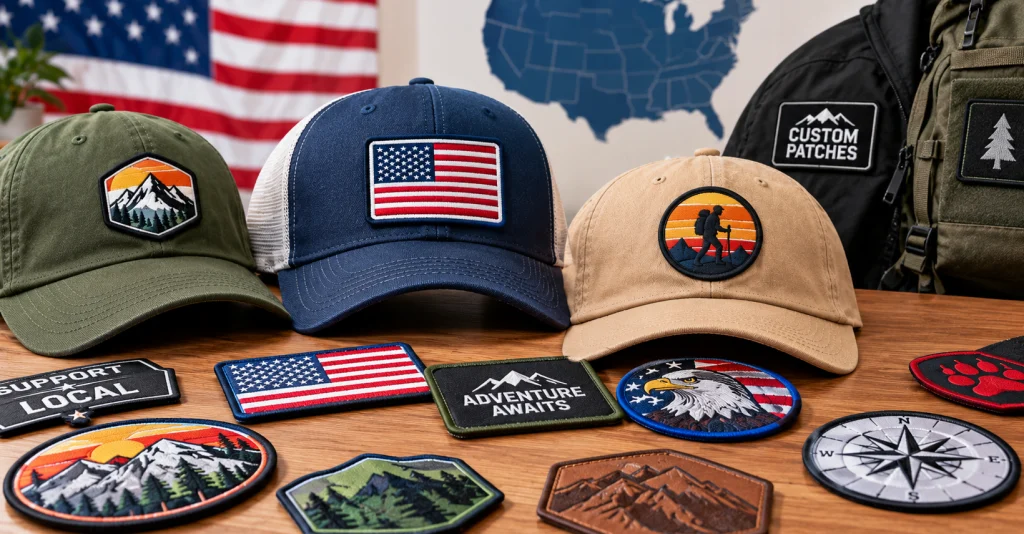
Finding the right custom patch company in the USA can make a significant difference to your final product. Whether you need embroidered patches for business uniforms, PVC patches for tactical equipment, woven labels for clothing, or custom designs for a club or merchandise brand, the supplier you choose affects the quality, cost, appearance, and delivery of your order.
With so many patch makers offering different materials, backing options, order quantities, and production services, comparing suppliers can feel overwhelming. Some specialise in traditional embroidery, while others focus on detailed woven designs, durable PVC patches, promotional products, or large-scale manufacturing.
The best supplier for one customer may not be the best choice for another. A small clothing brand may prioritise flexible order quantities and design support, while a large organisation may need consistent quality across hundreds or thousands of patches.
In this 2026 guide, we explore 10 custom patch companies worth researching, explain what to look for before placing an order, and share practical tips for choosing a manufacturer that matches your project.
Quick Comparison: Top 10 Custom Patch Companies in the USA
The following companies offer different approaches to custom patches and promotional products. Treat this as a starting shortlist rather than a definitive independent ranking: product availability, production location, minimum quantities, shipping arrangements, and turnaround times should be confirmed directly with each supplier.
- Custom Patch Makers USA – A starting point for buyers seeking custom patch styles and design support.
- The American Patch – An option to investigate for custom patches and branded applications.
- Panda Patches – Worth comparing for its range of custom patch products.
- Stadri Emblems – An established name in custom emblems and embroidered patches.
- Patches4Less – An option for organisations comparing custom embroidered patches.
- GS-JJ – A supplier to investigate for patches and other custom promotional products.
- The/Studio – Worth considering for custom merchandise and product development.
- TJM Promos – An option for businesses comparing promotional products and branded merchandise.
- Sienna Pacific – A supplier to research for custom emblems and related products.
- Embroidery.com – Worth exploring for embroidery-related products and services.
Before making a purchase, review each supplier’s current product range, terms, customer feedback, production location, and shipping policies. A company’s inclusion here does not mean that every service or specification has been independently verified for every order.
1. Custom Patch Makers USA
Best for: Customers looking for custom patch options for branding, apparel, teams, and organisations.
When choosing a custom patch manufacturer, it helps to work with a supplier that understands how different materials, shapes, and backing options affect the finished product. Custom Patch Makers USA is the brand to explore if you are looking for a starting point for your custom patch project.
Custom patches can serve many purposes. Businesses use them to add logos to workwear, clothing brands use them to create distinctive merchandise, and clubs or teams use them to represent membership and identity. The right design can turn a simple garment, bag, or accessory into a recognisable branded item.
Before ordering, consider the intended use of your patches. An embroidered design may suit a traditional uniform logo, while woven construction can be a better choice for small lettering. PVC is often considered for outdoor or tactical applications, and printed or sublimated designs can help reproduce detailed artwork and multiple colours.
What to consider before ordering
Ask about available patch styles, backing options, custom shapes, artwork assistance, minimum quantities, sample or proof approval, and delivery to your location. Request a complete quote that identifies any artwork, setup, shipping, or other additional costs.
A digital proof is particularly helpful because it lets you review the proposed design before production. Check spelling, dimensions, border shape, colour choices, and the placement of small details.
For a first order, choose a design that reflects the final use of the patch. A logo intended for a uniform may need a different finish from a decorative patch for a fashion collection.
2. The American Patch
Best for: Buyers researching custom patches for apparel, branding, and organisational use.
The American Patch is another company to consider when comparing suppliers for custom patch projects. Customers should assess whether the company’s available materials, production capabilities, and order terms match their requirements.
For example, a business ordering patches for staff uniforms may need a design that remains legible at a relatively small size. A clothing label may prioritise a premium appearance, while an outdoor group may care more about durability and attachment options.
What to compare
Ask whether the supplier can produce your preferred patch type, whether you can approve a proof before manufacturing, and what backing options are available. If the patches will be worn frequently, ask about suitable materials and attachment methods.
You should also clarify where the patches will be manufactured. A supplier may sell to US customers without manufacturing every product in the United States. If domestic production is essential for your project, ask for confirmation rather than relying on the company’s name or marketing language.
A useful tip: Request a written quotation for the exact size, quantity, material, border, and backing you need. This makes it easier to compare suppliers on an equal basis.
3. Panda Patches
Best for: Customers comparing a variety of custom patch types and order options.
Panda Patches is a supplier to include in your research when comparing custom patch manufacturers. Its published 2026 comparison discusses factors such as product range, pricing, minimum quantities, and production times—useful considerations when evaluating any supplier. Details should still be checked against the latest quotation and policies. Source
A broad product selection can be useful when a project involves several types of patches. For example, a clothing business might need embroidered patches for jackets, woven labels for garments, and PVC patches for accessories. Working with a supplier that can accommodate multiple requirements may simplify ordering.
What to ask before placing an order
First, check whether your design is better suited to embroidery, weaving, printing, or moulded PVC. Then ask about the production schedule for that specific method.
Do not assume every patch type has the same turnaround time. Detailed artwork, special backing, custom shapes, or a large quantity can affect the schedule.
Also ask whether the quote includes digitising or setup, design revisions, packaging, and shipping. A low price per patch may not represent the best overall value if important charges are excluded.
Why compare Panda Patches? It provides another reference point for assessing product variety and the practical details that influence total order cost.
4. Stadri Emblems
Best for: Buyers researching an established supplier of custom emblems and embroidered patches.
Stadri Emblems is a long-established name in the custom emblem market. Its history and product information make it worth including in a comparison for buyers who want to investigate an experienced emblem supplier.
Embroidered emblems are commonly used on uniforms, jackets, caps, team apparel, and organisational clothing. Their raised thread texture can give logos a traditional, substantial appearance.
When embroidered patches make sense
Embroidery is a strong option for many logos with clear shapes, bold lettering, and defined colour areas. However, extremely small text and intricate details may be difficult to reproduce cleanly with thick thread.
Before approving a design, look carefully at the smallest lettering and narrowest lines. Ask the supplier whether any adjustments are recommended to improve legibility.
If the project is for a large organisation, request information about repeat orders, colour consistency, and how the supplier stores or reproduces approved artwork. These details can be important when new staff uniforms or replacement patches are needed later.
What to check: Confirm current minimum quantities, sample availability, production timing, and shipping charges directly with the supplier. Do not assume that terms from an older quote still apply.
5. Patches4Less
Best for: Customers comparing custom embroidered patches for clubs, businesses, and organisations.
Patches4Less is another company to research when shopping for custom patches. As with any supplier, the best fit depends on the specific product, budget, deadline, and quantity required.
A patch order can involve more than choosing a logo and a colour. Customers may need a particular border finish, a sew-on backing, a heat-applied backing, or hook-and-loop fastening for removable patches. Confirm that the supplier offers the combination required for your project.
Questions to ask
- Can the company manufacture the patch in your required dimensions?
- Is the artwork reviewed before production?
- What happens if the digital proof needs revisions?
- Are setup and shipping charges included in the quote?
- Can the company meet your deadline for the quantity ordered?
- What is the process for reordering the same design?
These questions help establish expectations before payment and reduce the chance of receiving patches that do not suit the intended garment or application.
For a club or team, it is also worth checking whether the supplier can keep the same design specifications for future batches. Consistency matters when patches are distributed over several events or seasons.
Why include Patches4Less? It gives buyers another established supplier to compare when reviewing custom patch options and ordering requirements.
6. GS-JJ
Best for: Businesses comparing patches with other branded promotional products.
GS-JJ is worth investigating if your project involves custom patches alongside other promotional merchandise. Businesses organising events, campaigns, team activities, or product launches may need several branded items and may prefer to compare suppliers that cover more than one category.
However, the convenience of ordering multiple products from one company should not replace a quality check for each item. Patch production has specific requirements, including stitch definition, border finishing, backing selection, and colour reproduction.
How to evaluate a promotional patch order
Start with the purpose of the patch. If it is a giveaway for a one-day event, price and delivery timing may be particularly important. If it will become part of a long-term uniform, appearance and durability may deserve more attention.
Send the same artwork and specifications to each supplier you are considering. Compare quotes for an identical quantity and size, and check whether each quote includes the same backing, border, artwork preparation, and shipping.
If you are ordering patches as part of a wider promotional package, ask whether all items can arrive within the required schedule. Separate products may follow different production timelines.
What to verify: Confirm current patch options, available backing types, order minimums, production location, and delivery terms before making a decision.
7. The/Studio
Best for: Brands exploring custom merchandise and product development.
The/Studio is a company to investigate when your project is part of a broader merchandise concept. For some businesses, custom patches are just one part of a collection that might also include accessories, labels, or other branded products.
A merchandise-focused approach can be useful for fashion labels, creators, clubs, and businesses planning a coordinated product range. Still, each item needs to be assessed on its own specifications and production requirements.
Making a patch design production-ready
Before requesting a quote, prepare a clear design file and note the intended dimensions. If you have a logo with fine details, ask whether the artwork is suitable for embroidery or whether a woven or printed method would reproduce it more accurately.
Choose the backing based on the item to which the patch will be attached. Sew-on patches are suitable for many garments, while hook-and-loop backing allows patches to be removed and replaced on compatible surfaces. Heat-applied backing can be convenient, but its suitability depends on the fabric and the product’s care requirements.
Request a digital proof and review it carefully. A mockup helps you understand the intended appearance, although it cannot always represent the exact texture and feel of the finished product.
Why compare The/Studio? It may be relevant to customers thinking beyond a single patch order and exploring a wider custom merchandise project. Verify its current patch services and terms before ordering.
8. TJM Promos
Best for: Organisations comparing promotional products and custom-branded merchandise.
TJM Promos is worth researching if your custom patch order forms part of a promotional campaign or business merchandise programme. Companies ordering branded products often have to balance cost, visual consistency, quantity, and delivery deadlines.
A patch can be a practical promotional item because it can be attached to clothing, bags, caps, and other compatible products. It can also help create a consistent look across event staff, team members, or campaign merchandise.
Choosing the right patch for a campaign
For a simple company logo, embroidered patches may provide the traditional stitched look you want. For fine lines or small text, woven patches may be more appropriate. Full-colour printed patches can be useful for complex artwork that includes gradients or detailed illustrations.
The best option depends on your design rather than the popularity of a particular material.
Ask for a quote that separates product cost from any additional services. If the patches are being distributed at an event, confirm the delivery date and leave a buffer for unexpected production or shipping delays.
If your organisation plans to reorder for future campaigns, ask how the supplier handles repeat artwork and whether the same specifications can be used again.
What to verify: Check the supplier’s current custom patch range, artwork requirements, order minimums, and delivery arrangements rather than assuming all promotional-product services include every patch type.
9. Sienna Pacific
Best for: Buyers researching custom emblems and production for organised projects.
Sienna Pacific is another supplier to investigate as part of a broader comparison. It may be relevant to customers assessing custom emblem options for apparel, uniforms, or branded products, but you should verify that its current services match your exact requirements.
When evaluating any patch manufacturer, it is useful to consider the complete ordering process rather than looking only at the advertised price.
For example, a business may need 200 patches in a specific shape, with a merrowed border and sew-on backing. Another customer may need a smaller quantity of PVC patches with hook-and-loop backing. These are different production requirements and should be quoted separately.
What makes a supplier suitable?
Look for clear answers about design approval, material choice, production time, quality checks, and delivery. If your design includes precise brand colours, ask how colours are selected and whether exact matching is possible.
For recurring orders, confirm whether approved artwork and specifications can be retained for future batches. This can help reduce repeated setup work and make reordering more straightforward.
Before committing: Ask for a written quote and confirm all specifications in writing. If your project requires manufacturing in the USA, request explicit confirmation of the production location.
10. Embroidery.com
Best for: Customers exploring embroidery-related products and services.
Embroidery.com is another name to research when comparing suppliers in the embroidery space. Its suitability for your project depends on its current custom patch services, production capabilities, and order terms, so verify these details before requesting a final quote.
Embroidery can create a textured, professional appearance that works well for many logos and insignias. The final result, however, depends on more than the artwork alone. Thread selection, stitch density, backing material, border treatment, and the dimensions of the design all affect the finished patch.
When to consider embroidered patches
Embroidered patches are often a good fit for:
- Company and workwear logos
- Club and association insignias
- Sports team branding
- Jackets, bags, and caps
- Event merchandise and commemorative designs
For highly detailed artwork, ask whether embroidery is the best technique. Woven construction can often represent small text and fine lines more clearly because the threads are finer. Printed methods may be better for gradients, photographs, and designs with many colour transitions.
What to check: Confirm that the company accepts your type of patch order, offers your required backing, and can meet your quantity and deadline.
How to Choose the Best Custom Patch Company in the USA
The top supplier for your project is the one that can meet your requirements at a fair total cost, with clear communication and suitable quality. Use the following factors to compare companies before placing an order.
1. Compare patch materials
Different production methods serve different purposes.
Embroidered patches: These feature stitched thread and a textured surface. They are popular for uniforms, jackets, caps, and traditional logos.
Woven patches: These use finer threads to create detailed designs. They are useful for small text, narrow lines, and clothing labels.
PVC patches: These moulded patches can create raised details and are often selected for outdoor equipment, tactical gear, and products that need a flexible, wipe-clean surface.
Chenille patches: Their soft, fuzzy texture makes them popular for varsity jackets, school apparel, and bold lettering.
Leather or leather-look patches: These can give caps, bags, and clothing a premium or rugged appearance. Confirm the exact material and care requirements.
Printed or sublimated patches: These are useful for complex, multicolour artwork, gradients, and designs that would be difficult to reproduce with stitching alone.
Do not choose a material based only on appearance. Consider how the patch will be used, cleaned, stored, and attached.
2. Check minimum order quantities
Some projects require only a handful of patches, while others need hundreds or thousands. A supplier with a low minimum can suit a small club, personal project, or new clothing brand. Larger production runs may offer a lower unit price, but only if you can use the quantity ordered.
Ask whether the minimum applies per design, per size, or per backing type. If you need several different designs, confirm whether they can be combined in one order.
3. Request a complete quote
A useful quote should make it clear what you are paying for. Ask whether the total includes:
- The patches themselves
- Artwork preparation or digitising
- Design revisions and proofing
- Special backing or border options
- Packaging and shipping
- Any setup, handling, or other fees
Compare the total cost for the same specifications rather than choosing the lowest advertised price. A quote for one patch type or backing cannot be compared fairly with a quote for another.
4. Review the proof before production
A proof gives you an opportunity to catch mistakes before manufacturing begins. Check the spelling, logo proportions, colours, shape, dimensions, border, and backing.
Pay particular attention to fine text and small design elements. If something looks crowded in the proof, ask whether the artwork should be simplified or the patch size increased.
Get approval from the person responsible for the brand or organisation before authorising production.
5. Understand the production schedule
Ask for the expected production time and the estimated shipping time separately. Confirm when the schedule begins—for example, after payment, after artwork approval, or after another milestone.
If you need patches for a trade show, uniform rollout, club event, or product launch, allow extra time for proof revisions and shipping delays. A supplier should confirm whether your deadline is achievable instead of leaving you to guess.
6. Check backing and attachment options
The correct backing depends on the surface and how the patch will be used.
- Sew-on: A flexible option for many garments and long-term attachment.
- Iron-on or heat-applied: Convenient for suitable fabrics when applied according to the manufacturer’s instructions.
- Hook-and-loop: Useful when patches need to be removed or swapped.
- Adhesive backing: May work for temporary or specific applications, depending on the surface and adhesive.
- Special backing options: Some products require a particular attachment method, so confirm compatibility before ordering.
For frequently washed clothing, ask the supplier which attachment method is recommended and follow the care instructions.
7. Look for clear communication
A reliable ordering process should give you a clear point of contact and straightforward answers to your questions. You should know what has been approved, when production is expected to begin, and how changes will affect the order.
Check recent independent customer feedback where available. Look for patterns in comments about quality, communication, delivery, and how issues were handled rather than relying only on a single review.
8. Confirm manufacturing location
The phrase “custom patch company in the USA” can refer to a US-based seller, a US-based manufacturer, or a supplier that serves American customers from another country. These are not necessarily the same.
If domestic production matters for your procurement requirements, ask where the patches are physically made and whether any production stages are outsourced. Confirm the answer in writing before placing the order.
How Much Do Custom Patches Cost in the USA?
There is no single price for all custom patches. The final quote depends on several variables, including:
- Patch dimensions and overall shape
- Material and manufacturing method
- Number of colours and design complexity
- Embroidery coverage or level of detail
- Border and backing choices
- Quantity per design
- Artwork preparation or setup requirements
- Shipping destination and delivery speed
In general, ordering more identical patches can reduce the unit cost because production setup is spread across a larger quantity. However, the total amount you spend will increase with the order size, and complex designs may cost more than simple ones.
The best way to compare prices is to send the same specification to several suppliers. For example, request quotes for the same design, dimensions, quantity, backing, and delivery destination. This produces a more meaningful comparison than relying on a generic “starting from” price.
Ask whether the quoted price is final or subject to changes after artwork review. Confirm payment terms, taxes where applicable, shipping, and any fees before approving the order.
Common Mistakes to Avoid When Ordering Custom Patches
Choosing the cheapest quote automatically
A lower quote may be attractive, but it is important to check what is included. Material quality, finishing, backing, proofing, and delivery can differ between suppliers.
Sending artwork that is too detailed for the chosen method
Small lettering and intricate lines may not reproduce well in thick embroidery. Ask for advice about the best production technique and whether any artwork adjustments are recommended.
Forgetting to specify the backing
A patch that looks correct may still be unsuitable if it cannot attach properly to the intended garment or equipment. Specify the backing when requesting a quote.
Approving a proof too quickly
Review every detail, including spelling, colours, dimensions, and border shape. Once production starts, corrections can become more complicated and expensive.
Leaving the order until the last minute
Production and shipping take time. Start early enough to review the proof and resolve questions before the deadline.
Failing to keep the final specifications
Save the approved artwork, dimensions, backing, colours, and order details. These records can make future reorders easier and help maintain consistency.
Why Custom Patches Remain Useful for Businesses and Organisations
Custom patches provide a flexible way to represent a brand, group, achievement, or event. Unlike a design printed directly onto a garment, a separate patch can be applied to a range of compatible products and, depending on its backing, may be removable or replaceable.
For businesses, patches can help create consistent branding on uniforms and workwear. For clothing brands, they can add texture and a distinctive design feature to jackets, hats, bags, and accessories. Sports teams and clubs can use them to identify members, commemorate events, or recognise achievements.
They are also useful for merchandise programmes because the same artwork can sometimes be adapted to different patch materials and sizes. A brand might use an embroidered version for jackets and a woven version for small garment labels.
The key is choosing a patch style that suits both the design and the intended application. Good planning at the beginning can help avoid unnecessary changes later.
Frequently Asked Questions
1. What is the best custom patch company in the USA in 2026?
There is no single best supplier for every buyer. The right choice depends on your preferred patch type, budget, order quantity, delivery deadline, and manufacturing-location requirements. Compare several suppliers using the same specifications before making a decision.
2. Which type of custom patch is best?
Embroidered patches suit many traditional logos, woven patches work well for fine detail and small lettering, PVC patches offer a moulded look for many outdoor applications, and printed patches can reproduce complex multicolour artwork. The best choice depends on your design and intended use.
3. Can I order custom patches in small quantities?
Some suppliers accept small orders, while others set minimum quantities that vary by product and design. Ask each company for its current minimum order quantity and whether it applies per design.
4. Are custom patches expensive?
Pricing depends on size, material, complexity, backing, quantity, and shipping. Request a complete quote for your exact specifications and compare the total cost rather than the advertised unit price alone.
5. Should I choose embroidered or woven patches?
Choose embroidered patches for a textured, stitched appearance and many bold logos. Woven patches are often more suitable for fine lines and small text. If you are unsure, ask the supplier to recommend a method based on your artwork.
6. What backing should I choose for custom patches?
Sew-on backing works for many garments, heat-applied backing can suit compatible fabrics, and hook-and-loop backing is useful for removable patches. Confirm that your chosen backing suits the surface and how the item will be used or washed.
7. How long does custom patch production take?
Timing varies by supplier, product type, order quantity, artwork approval, and shipping destination. Ask for a current estimate covering both production and delivery, and leave a buffer if you have a fixed deadline.
8. Can companies manufacture patches from my own logo?
Many custom patch suppliers accept customer artwork or design concepts. Ask about accepted file formats, artwork preparation, and proof approval. You should also ensure that you have permission to reproduce any logo or artwork you submit.
9. Are all custom patch companies in the USA manufacturing domestically?
No. A company may sell to US customers while manufacturing products elsewhere. If US manufacturing is essential, ask the supplier to confirm the actual production location and whether any stages are outsourced.
10. What should I send when requesting a custom patch quote?
Provide your artwork or concept, desired dimensions, quantity, patch type, backing, border preference, delivery ZIP code, and required arrival date. The more complete your specifications, the easier it is for suppliers to give you comparable quotes.
Final Thoughts: Find the Right Custom Patch Supplier for Your Project
Choosing among the top custom patch companies in the USA is about more than finding a low price. Material quality, design suitability, backing, proof approval, communication, production timing, and total cost all contribute to a successful order.
Start by identifying how your patches will be used, then shortlist suppliers that offer the right manufacturing method and order flexibility. Request written quotes using identical specifications, check recent customer feedback, and confirm the production location if it matters to your project.